Praxis Innovations
Services How it works FAQ Resources Book a free call
Home/Services/New Product Development
“I have a prototype…”

New Product Development

You've built something that works. We turn that working prototype into a product that can be manufactured at scale — with the techniques, documentation and engineering materials a factory needs.

Book a free evaluation See the process
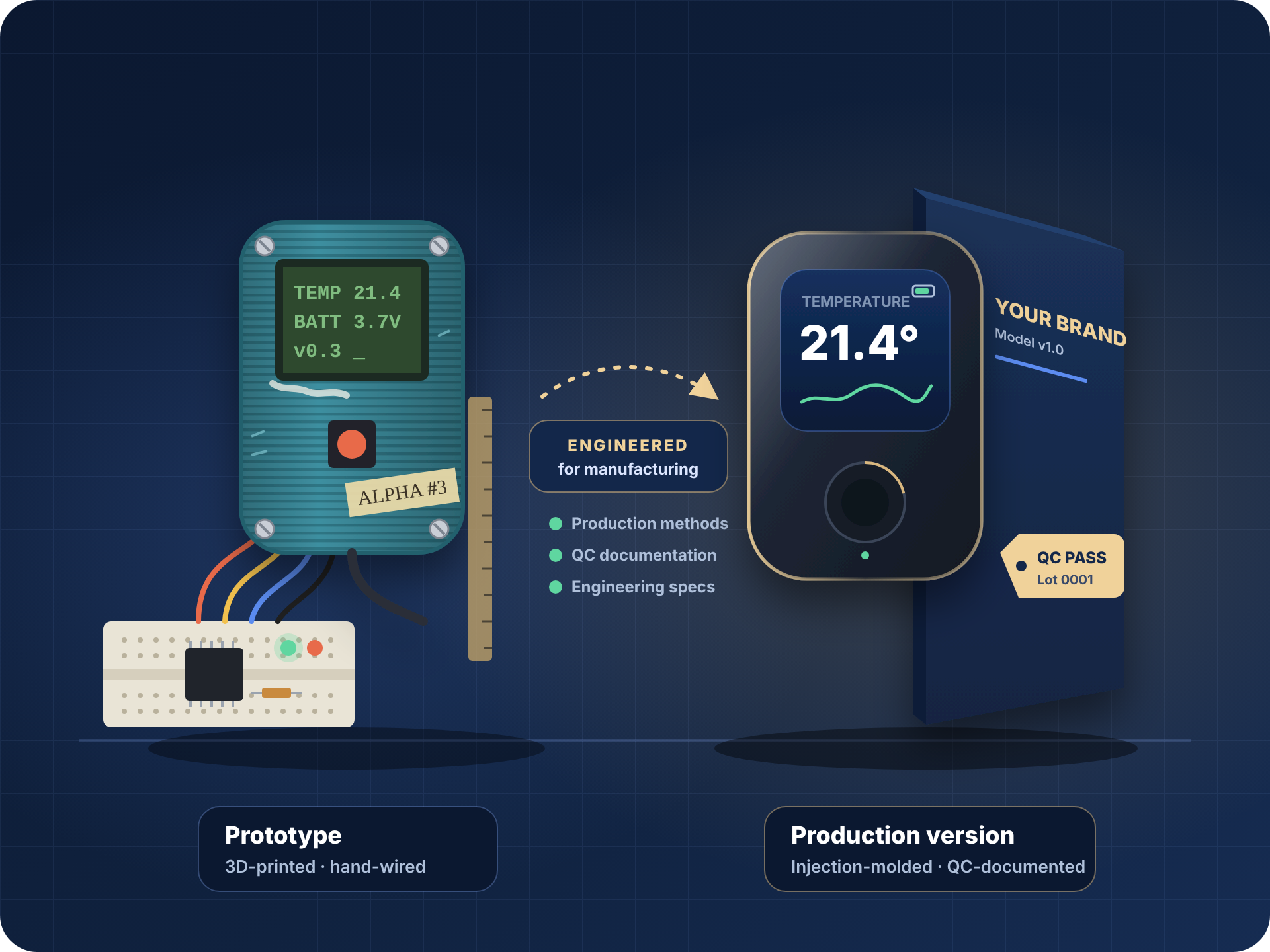
Illustration of a rough 3D-printed, hand-wired prototype next to its finished, injection-molded production version, connected by an arrow labeled engineered for manufacturing.

What you get

The three things that stand between a prototype and a production run.

1

Manufacturing techniques

How your product will actually be made at volume: processes, materials, tooling and the order of operations.

2

Quality control documentation

The specifications and inspection steps that keep every unit consistent, whoever builds it. Quality control always stays yours.

3

Engineering materials

The drawings, specs and supporting documents a manufacturer needs to quote and produce your product.

From prototype to production

Every project runs on a written project management plan, so you always know the next step, its cost and who owns it.

Start at any step. Many clients come to us partway through.

  1. 1
    Evaluate the prototypeA free first look at what you have, what works and what has to change for production.
  2. 2
    Engineer for manufacturingDevelop the manufacturing techniques and engineering materials for large-scale production.
  3. 3
    Test the materialsDurability and environmental testing through our sister company, BeoWolf Testing & Development.
  4. 4
    Document quality controlQC documentation so every manufacturer builds it the same way.
  5. 5
    Source a manufacturerMatched from 1,500+ North American vendors, or overseas when that fits better.
  6. 6
    Low-run launch, then scaleTest the market with a small run before committing to full production.

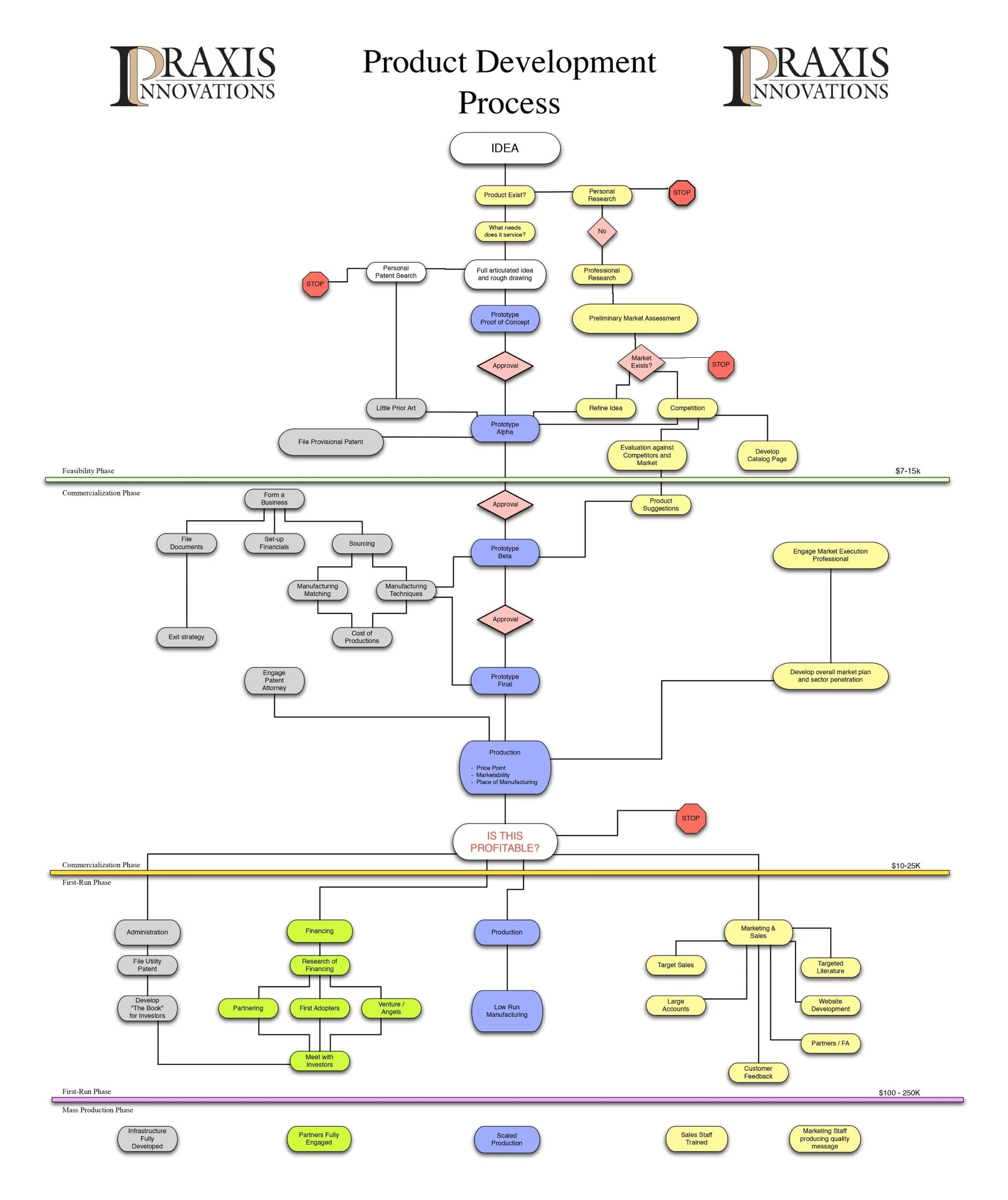
What it takes to get to market

The steps and typical costs for a non-software product, from idea to mass production.

  1. 1Feasibility$7–15K
  2. 2Commercialization$10–25K
  3. 3First run$100–250K
  4. 4Mass productionScaled to demand
  • Product
  • Market & sales
  • Business, IP & sourcing
  • Funding
1

Feasibility

Is the idea new, wanted and buildable?

$7–15K

Product

  1. Start with the idea
  2. Define the need it serves
  3. Fully articulated idea and rough drawing
  4. Prototype: proof of concept → approval
  5. Prototype: alpha

Market

  1. Does the product already exist? (personal research)
  2. Professional research
  3. Preliminary market assessment
  4. Study the competition and refine the idea
  5. Evaluate against competitors and market
  6. Develop a catalog page

IP

  1. Personal patent search
  2. Little prior art found
  3. File a provisional patent

Decision point: does a market exist? If the product already exists, there's too much prior art, or there's no market, we stop here, before you spend more.

2

Commercialization

Turn the prototype into a business plan.

$10–25K

Product

  1. Prototype: beta, shaped by product suggestions → approval
  2. Prototype: final
  3. Production plan: price point, marketability and place of manufacturing

Market

  1. Product suggestions from the competitor evaluation
  2. Engage a market execution professional
  3. Develop the overall market plan and sector penetration

Business & sourcing

  1. Form a business: file documents, set up financials, plan the exit strategy
  2. Sourcing: manufacturing matching and techniques
  3. Cost of production
  4. Engage a patent attorney

Decision point: is this profitable? Price point, production cost and market plan have to add up before the first run. If they don't, we stop.

3

First run

Make a limited run, sell it and raise capital.

$100–250K

Product

  1. Production
  2. Low-run manufacturing

Marketing & sales

  1. Target sales and large accounts
  2. Targeted literature and website development
  3. Partners and first adopters
  4. Customer feedback

Administration

  1. File a utility patent
  2. Develop "the book" for investors

Financing

  1. Research financing
  2. Partnering, first adopters, venture capital and angels
  3. Meet with investors
4

Mass production

Everything in place to scale.

Scaled to demand

Product

  1. Scaled production

Sales

  1. Sales staff trained
  2. Marketing staff producing a quality message

Business

  1. Infrastructure fully developed

Funding

  1. Partners fully engaged

Costs are typical ranges for a non-software product and vary by project. View the original chart

Questions about product development

Do I need a finished prototype?

A working prototype is the ideal starting point. If you're earlier than that, we can connect you with prototype designers from our network.

Who owns the designs and documentation?

You do. We work on a work-for-hire basis, so the product, the results and the intellectual property stay yours.

Should I patent it first?

We recommend an independent evaluation before you spend on attorneys. We can point you to USPTO-registered professionals when you're ready.

How long does it take, and what does it cost?

It depends on the product. [ANSWER FROM REX: typical timeline and how projects are priced]

Related services

“Will it hold up?”Material Testing “I need someone to make it…”Sourcing “My project keeps slipping…”Project Management “I want royalties, not a factory…”Licensing & Franchising

Have a prototype? Let's talk.

Book a free one-hour call, or reach us at info@PraxisInnovations.com.

Book a free call 859-327-8322
© 2026 Praxis Innovations · Lexington, Kentucky Start-up ecosystemPaymentPrivacy
0